‘Healthy taxation’ conference in Georgia amid debate on new tobacco excise proposal
wiiw joined consultations in Georgia as stakeholders reviewed a draft law that would overhaul the country’s cigarette excise system. During the meetings, experts presented research findings and highlighted concerns over revenue, health impacts and policy alignment.
By Nora Kungl and Biljana Jovanovikj
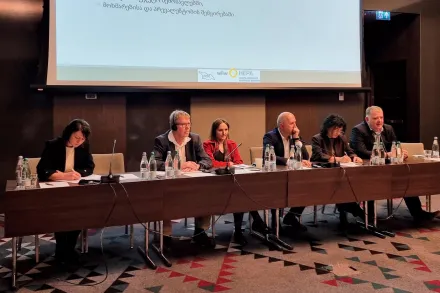
‘Healthy Taxation for Georgia’, a conference organised by the FCTC Monitoring and Implementation Center in Georgia (FCTC MICG) as part of the Tobacco Taxation in Eastern Europe network, was held in Tbilisi on 25 November. The event came at a pivotal moment, following the publication of a draft law proposing major changes to the country’s cigarette excise structure.
The draft law, published on 20 November, introduces an excise tax advantage for domestically produced cigarettes and shifts the excise structure of imported cigarettes towards a higher share of specific excise tax while reducing the ad valorem component. As the table below shows, for imported cigarettes, the specific excise would rise from 1.9 Georgian lari (GEL) per pack to GEL 2.75, while the ad valorem rate would fall from 30% to 20%. For locally produced cigarettes, a preferential excise rate would apply to a limited quota of 35 million packs, taxed at GEL 1.3 per pack plus 15% of the retail price. Although the draft is presented as a tax increase for imported cigarettes, initial assessments show that – due to the shift towards the specific excise component – most imported brands would see no meaningful rise in total excise, and higher-priced products would in fact face a decrease in total excise duty.
The Parliament of Georgia approved the draft law, under an accelerated procedure, on 26 November. The new excise structure will enter into force on 1 January 2026. This follows the moderate excise increase at the start of 2025 after five years without any adjustments.
Table 1 / Excise tax rates on cigarettes and HTPs
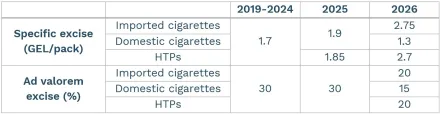
Source: draft law and its amendment regarding HTPs
The conference had a dual purpose: originally planned to present the project’s research findings, it also became a timely platform to address the newly released draft law and raise concerns about the proposed restructuring. It gathered representatives from the Revenue Service of Georgia, the National Center for Disease Control, the country offices of the World Health Organization (WHO) and the United Nations Development Programme (UNDP), civil society groups and international research institutions, including wiiw and the University of Cape Town (UCT).
The discussions opened with an overview by wiiw economist Biljana Jovanovikj, who outlined tobacco consumption and taxation trends across Central, Eastern and Southeastern Europe, showing that Georgia’s current system lags behind regional best practice and EU expectations. She highlighted that cigarettes have continued to become more affordable – driven by income growth and inflation – while excise rates have remained largely unchanged since 2019.
Corne van Walbeek, Director of the Research Unit on the Economics of Excisable Products (REEP) at UCT, highlighted the concerns of international experts over the draft law’s tax design. He showed that only the cheapest cigarettes would face a higher total excise burden, while the restructuring would result in an excise tax decrease for mid- and higher-priced brands, which are predominantly imported. Moreover, if importers raise prices in the coming years, a larger share of the price increase would accrue to the tobacco industry rather than the state budget (compared with the current tax structure), making the whole endeavour counterproductive.
For domestic cigarettes, the reduction of both excise components would cause substantial tax revenue losses. Depending on how much of the reduction is passed through to consumers, the estimated loss for 2026 is close to GEL 80 million, assuming sales of the 35 million packs covered by the quota.
Participants stressed that the restructuring would undermine progress made between 2015 and 2019 as well as the implemented 2025 increase, risking both revenue losses and setbacks in public health efforts.
Above all, the proposed changes are not aligned with WHO recommendations calling for equal taxation across tobacco products, and they risk violating non-discrimination principles of the World Trade Organization (WTO).
Finally, the modelling work presented by local expert Vano Tsertsvadze, a professor at the Georgian Institute of Public Affairs (GIPA), highlighted alternative policy directions. Simulation results using the Tobacco Excise Tax Simulation Model (TETSiM) showed that raising the specific excise tax by 20% annually would most effectively prevent cigarettes from becoming more affordable (driven by inflation and income growth) in addition to securing stronger health and revenue outcomes. Overall, the results highlight that one-time increases are insufficient, and that regular, substantial increases in the specific excise tax are needed to achieve meaningful fiscal and public health impacts.
Beyond tobacco, the conference also touched on the taxation of other harmful products. wiiw Senior Research Associate Hana Ross presented developments in sugar-sweetened beverage (SSB) taxation, outlining current tax models and international best practices. She noted that SSB taxes – now adopted in a growing number of countries – can strengthen both revenues and public health. Lastly, she highlighted that such measures could offer Georgia a viable next step as policy makers consider broader strategies to tackle non-communicable diseases.