
Policy roundtable examines evidence-based tobacco-taxation reforms in Kosovo
Participants called for a new tobacco excise tax calendar in Kosovo, arguing that taxes should keep pace with inflation and income growth to reduce the affordability of cigarettes and youth prevalence in addition to strengthening tax revenue and public health
By Nora Kungl and Biljana Jovanovikj
Researchers and local stakeholders gathered on 24 June in Pristina for the roundtable “Tobacco Taxation in Kosovo and the Western Balkans” to discuss the latest evidence on tobacco use and taxation. The event, co-organised by the Riinvest Institute, wiiw and the OECD, addressed Kosovo’s severe tobacco epidemic and its long-term consequences, highlighting tobacco taxation as a cost-effective policy tool in an area where Kosovo significantly underperforms compared to neighbouring countries.
Data presented at the event showed that Kosovo’s smoking prevalence remains among the highest in the region. While adult prevalence was last recorded at 36% in 2019 (49% for men and 24% for women), more recent data from 2024 show a concerning level of tobacco use among youth: 28% of students smoked cigarettes in the last month, and 23% used e-cigarettes.[1] The use of both e-cigarettes and conventional cigarettes has sharply risen over time in Kosovo, a trend that contrasts with most European countries, where growth in new tobacco product use has generally been accompanied by declining cigarette smoking. These trends are particularly concerning given Kosovo’s young population, with 46% of residents being under the age of 30.
Kosovo currently has the lowest level of cigarette taxation in the region, with an excise duty of EUR 55 per 1,000 cigarettes. This is not only well below the current EU minimum of EUR 90 but also significantly lower than in most EU candidate countries. Kosovo’s rate is only comparable to Turkey’s, while remaining below those of all other Western Balkan countries and the broader CESEE region (see Figure 1). This gap is expected to widen further, as the forthcoming revision of the EU Tobacco Taxation Directive (EU TTD) will likely drive additional tax increases in neighbouring countries, such as Montenegro, whose current excise calendar already reflects the planned adjustments.
Figure 1 / Minimum excise tax rate as of January 2026, EUR per 1,000 cigarettes
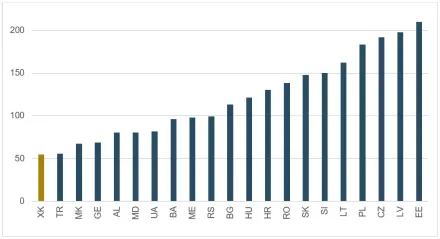
Notes: AL, XK: cigarette taxation consists of only a specific excise tax. GE: There is no minimum excise rate; the rate shown in the figure is the sum of the ad valorem and specific excise at the price of the most sold brand. TR: The rate shown is the sum of the specific excise rate and the minimum ad valorem rate.
Sources: Authors’ calculation based on various sources.[2]
The evidence presented also showed that cigarettes have become more affordable over time, as excise tax increases under the 2016-2019 and 2020-2024 tax calendars were outpaced by inflation and strong income growth. Moreover, no excise increase has been implemented since January 2024, further eroding the real value of tobacco taxation.
Overall, the findings suggest that previous tobacco tax policies have not been sufficient to induce meaningful behavioural change. To address these challenges, experts called for:
- The introduction, as soon as possible, of a third cigarette excise tax calendar with automatic indexation with inflation and real income growth to ensure that cigarettes become progressively less affordable over time.
- The broadening of the calendar to all tobacco and nicotine products to limit substitution across products following a cigarette tax increase.
- The increase in taxation levels of fine-cut tobacco, heated tobacco products, and liquids for e-cigarettes to prevent youth initiation and reduce substitution effects.
- Further efforts to keep illicit trade in tobacco products at low levels.
- The integration of an ambitious tobacco tax policy into a comprehensive tobacco control strategy to achieve lasting public health outcomes for Kosovo.
Notes:
[1] Sources: Survey on Tobacco Consumption in Southeastern Europe (STC-SEE) (2019), European School Survey Project on Alcohol and Other Drugs (ESPAD) (2024).
[2] EU: European Commission, Taxes in Europe Database, situation on 1.1.2026. RS: Ministry of Finance, Tobacco Administration, minimum excise rate valid from 2.8.2025; BA: Indirect Taxation Authority; ME: Law on Excise Duty, dated 1.10.2024; AL: Fiscal Legislation Bulletin, Ministry of Finance, General Directorate of Tax Policies; MK: Amendments to the Law on Excise (Official Gazette No. 2023/209); XK: Government Decision No. 03/18, dated 29.7.2020. Exchange rates as of January 2026 (Eurostat).